 RANTHAMBORE
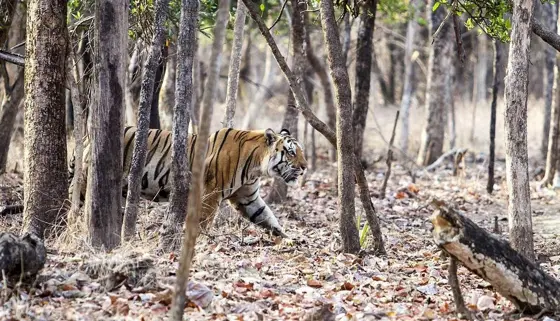
Bengal tiger in Ranthambore
Bengal tiger (Panthera tigris tigris): Dry deciduous forest, lake edges, valley corridors and the open outer park; every zone holds tigers.
Ranthambore Tiger books safari permits in your name — we are not the Rajasthan Forest Department and not the official park booking website.
Check availability for your date
Check my date on WhatsApp →Reply in 2 min · 7am–10pm · pay only after we confirm
Prefer to pay online now? Book & pay online →
Phone optional here · we reply by email, usually within the hour (7am–10pm)
In one line: Bengal tiger (Panthera tigris tigris) — IUCN Red List: Endangered. Dry deciduous forest, lake edges, valley corridors and the open outer park; every zone holds tigers.
| Scientific name | Panthera tigris tigris |
| IUCN status (global) | Endangered |
| Legal protection in India | Protected under Schedule I of India’s Wildlife (Protection) Act; monitored by the NTCA; the reserve’s count is around 70 including cubs. |
| Where our guides see it most | zone 3 (Padam Talao and Rajbagh), zone 4 (Malik Talao and Lakarda), zone 2 (Phuta Kot and the waterholes), zone 6 (Kundal), zone 1 (Singh Dwar and Sultanpur), zone 5 (Kachida valley and Bakaula) |
“Where our guides see it most” is a habitat pattern from our own safaris in recent seasons, not a live location. Content checked 4 November 2026.
Identification
Up to 3 m nose to tail and 200–260 kg for a male; orange coat with black stripes unique to each animal, which is how the Forest Department tells individuals apart and gives them T-numbers.
Habitat in Ranthambore
Dry deciduous forest, lake edges, valley corridors and the open outer park; every zone holds tigers.
Got a date in mind? Send it on WhatsApp. We check live seats and reply in minutes, 7am–10pm.
Check my date on WhatsAppBehaviour
Solitary and territorial; hunts sambar and chital, mostly at dawn, dusk and in the cooler hours; comes to water in the heat.
When to look
Through the season (October–June); from March, when the leaves fall and the heat drives tigers to water, sightings at the lakes and waterholes are most frequent. Morning and afternoon drives both work; the afternoon is better in summer.
Worth knowing
Ranthambore’s tigers are among the most watched in the world; Machli (T-16) lived to about 19 here. India held an estimated 3,682 tigers in the 2022 count (NTCA/WII).
Sold out online? Ask us. We book from the daily current and tatkal quotas, and you pay only after we confirm availability, with a full refund if the permit can’t be issued.
Check my date on WhatsAppPhotography
Keep the sun behind you on the lake edge; a 300–600 mm lens for distant walks, something wider for the fort-and-lake frame. Never ask the driver to go off-track or crowd an animal.
Conservation
Protected under Schedule I of India’s Wildlife (Protection) Act; monitored by the NTCA; the reserve’s count is around 70 including cubs. Status is the IUCN Red List global category; it describes the species worldwide, not the Ranthambore population.
Questions
How many tigers are there in Ranthambore?
About 70 including cubs by the Forest Department’s recent counts; estimates vary year to year. India as a whole held an estimated 3,682 tigers in the 2022 NTCA/WII count.
Will I see a tiger?
Nobody can promise it. Two nights and three or four safaris across different zones give the best realistic odds; see our honest guide to the chances.
Which zone is best for tigers?
There is no reliable public sighting data per zone, so we do not rank them. The lake zones (2, 3, 4) and zone 6 have been consistently productive in our drivers’ experience.
Other wildlife of Ranthambore
Indian leopard · Sloth bear · Striped hyena · Golden jackal · Mugger (marsh crocodile) · Sambar deer · Chital (spotted deer) · Nilgai (blue bull) · Wild boar · Chinkara (Indian gazelle) · Hanuman langur · Red-headed vulture · Indian peafowl · Caracal
Dated sightings archive
Verified entries for this species from our sightings archive: dated, zone-level, sourced. Not a live position.
Loading the archive…
Sources and how we know
Species facts follow standard references (IUCN Red List, the Wildlife Institute of India and NTCA status reports). “Where our guides see it most” is our drivers’ own experience from recent seasons: a habitat pattern, never a live location or a promise.
- Research IUCN Red List of Threatened Species (global categories)
- Research Status of Tigers in India 2022: summary report (NTCA and Wildlife Institute of India)
- Official National Tiger Conservation Authority (NTCA), Government of India
- Official Rajasthan Forest Department
- Press “Most photographed tigress Machli dies at Ranthambore”, PTI via Business Standard, 18 Aug 2016
- Press “Famous Ranthambhore tigress Arrowhead dies of brain tumour”, PTI via The Week, 19 Jun 2025
Spotted an error? Tell us and we correct it: see our editorial and corrections policy.