Jeep and gypsy are the same vehicle. What a seat costs in 2026, how zones are allocated, and which one to book.
Phone optional here · we reply by email, usually within the hour (7am–10pm)
If you have been searching for a "jeep safari" and finding pages that only talk about a "gypsy", here is the thing nobody explains: they are the same vehicle. The Maruti Gypsy is the open 4×4 that every operator in Ranthambore calls a jeep in conversation and a gypsy in writing. There is no third option you are missing.
The real choice in Ranthambore is between that open jeep and the canter — a 20-seat open bus. Almost everything else about the two is identical: the same park, the same zones, the same two daily shifts, the same guides, the same permits from the Rajasthan Forest Department. What differs is how many people you share the drive with, what it costs, and how easily you can get one at short notice.
| Gypsy / jeep | Canter | |
|---|---|---|
| Seats | 6 guests | 20 guests |
| Price per seat | from ₹2,999 | from ₹1,999 |
| Whole vehicle | from ₹15,999 | Not sold privately |
| Height | Low, eye-level | Raised, above the scrub |
| Photography | Much better | Workable, more heads in frame |
| Availability | Sells out first | Usually available later |
| Noise | Quieter | Louder, more movement |
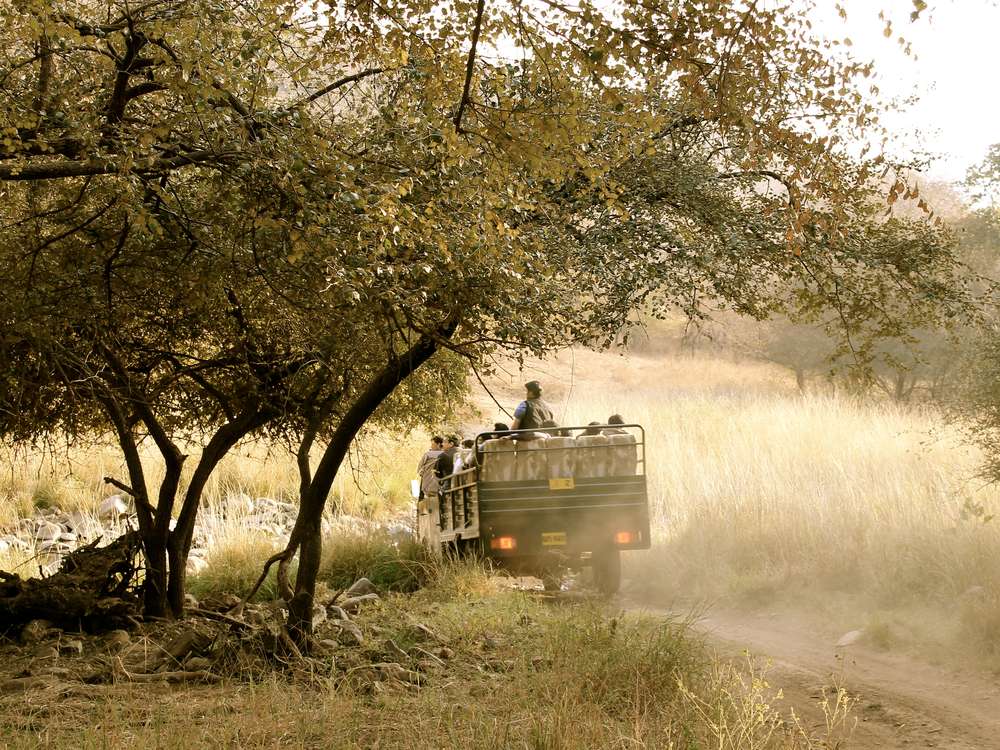
Book a gypsy if you care about photographs, you are travelling as a couple or a small group, or you simply want a quieter drive. Being low and close to the ground matters more than people expect — a tiger walking past at eye level from a gypsy is a different experience from watching it from a raised bench with nineteen other people.
Book a canter if the cost per head matters, you are a family or a larger group, or — and this is the common one — you are booking late. Gypsy permits are limited and go first, particularly for weekends and the December–January peak. A canter seat on the right date beats a gypsy seat you cannot get.
Book a private gypsy if you want the whole vehicle to yourselves. You pay for all six seats, you are not sharing with strangers, and you have a far better chance of the driver working the zone patiently rather than rushing between sightings to satisfy a mixed vehicle.
Check availability for your dates →
Safari fares are set by the forest department, not by operators, and they are the same whoever you book through. As a guide, a gypsy seat runs about ₹2,200–2,500 and a canter seat about ₹1,500–1,700 per shift for Indian nationals, with a roughly 10% increase applied in April 2026. Foreign nationals pay approximately double. A whole private gypsy is six seats plus the vehicle, which works out around ₹13,000–15,000 a drive.
Any operator quoting far below those numbers is either quoting a canter while you are picturing a jeep, or has not included the permit. Ask which vehicle and which zone before you compare two prices.
Ranthambore runs two safari shifts a day, morning and afternoon, each lasting roughly three to three and a half hours. Exact times shift with the season — the morning drive leaves around dawn, which in winter means a pickup somewhere near 6:00 to 6:30 am, and the afternoon drive returns around sunset.
Both shifts see tigers. Mornings are colder and often quieter, with better light early; afternoons warm up and animals move toward water. If you can only do one, do the morning. If you are serious about a sighting, do several — which is the honest answer to most questions about Ranthambore.
The park is divided into ten safari zones. Zones 1–5 are the original core around the lakes and the fort, and they open on 1 October. Zones 6–10 are buffer areas that stay open longer in the year and, in many seasons, produce excellent sightings of their own.
You will find a great deal written online about which zone is best. The truthful version is less satisfying: there is no permanently best zone. Tigers are territorial but they move — see how Ranthambore's famous tigresses passed the lake territory down four generations — territories change as cubs grow and disperse, and a zone that was extraordinary two seasons ago may be ordinary now. Anyone promising you a specific zone because it is "the tiger zone" is selling certainty that does not exist.
What genuinely improves your odds is doing more drives across different zones. Three drives spread over two or three zones will beat one drive in whichever zone was famous last year, every time.
Zone allocation is also not something an operator controls. Permits are issued through the forest department's system and zones are assigned by it. We can request a zone and we will tell you honestly whether the request is likely to be granted — but nobody can guarantee one, and you should be wary of anyone who says otherwise.
Permits are released in advance and the good dates go early, particularly weekends, the Diwali and New Year weeks, and the whole of December and January. Booking a week ahead in peak season usually means a canter rather than a gypsy.
We confirm the permit before you pay anything — see how Ranthambore safari booking works for the full sequence, the ID documents the forest department requires, and what happens if the department cancels a drive. If you would rather have the room, the meals and the drives arranged as one number, our stay and safari packages start at ₹7,999 per couple per night.
Coming from out of state? Getting to Ranthambore covers trains and roads from Delhi and Jaipur — and the timing trap that catches people out, which is that you cannot arrive on the morning train and make that morning's drive.
Yes. The open 4×4 used in Ranthambore is a Maruti Gypsy, and "jeep" and "gypsy" are used interchangeably for it. There is no separate jeep option.
A gypsy is better for photography, small groups and a quieter drive. A canter is cheaper per person, suits larger groups and is far easier to get at short notice. Both go to the same zones on the same shifts.
Roughly ₹2,200–2,500 per seat per shift for Indian nationals at 2026 forest-department rates, or about ₹13,000–15,000 for the whole six-seat vehicle. Foreign nationals pay approximately double.
There is no permanently best zone. Tigers move and territories change between seasons. Doing more drives across different zones improves your chances far more than targeting one zone.
You can request one, but zones are allocated by the forest department's permit system and no operator can guarantee a specific zone.
There are two shifts a day, morning and afternoon, each about three to three and a half hours. Timings move with the season; the morning drive leaves around dawn, roughly 6:00 to 6:30 am in winter.
 RANTHAMBORE