What really decides a Ranthambore tiger sighting, and how to plan your safaris for the best odds.
Ranthambore Tiger books safari permits in your name — we are not the Rajasthan Forest Department and not the official park booking website.
Reply in 2 min · 7am–10pm · pay only after we confirm
Phone optional here · we reply by email, usually within the hour (7am–10pm)
Short answer: your chances of seeing a tiger in Ranthambore are good but never certain. One safari is a real chance, not a likely one, especially in winter. Two nights and three or four drives, mixing core and outer zones, give most visitors a good chance, and April to June is the easiest time because tigers stay close to water. No zone is permanently best: the Forest Department allots zones, and tigers move.
Last checked 2 November 2026. Tiger numbers are from the Rajasthan Forest Department’s July 2026 count; sighting advice comes from our own bookings and the guides we work with. Nobody can promise a tiger, and you should be wary of anyone who does.
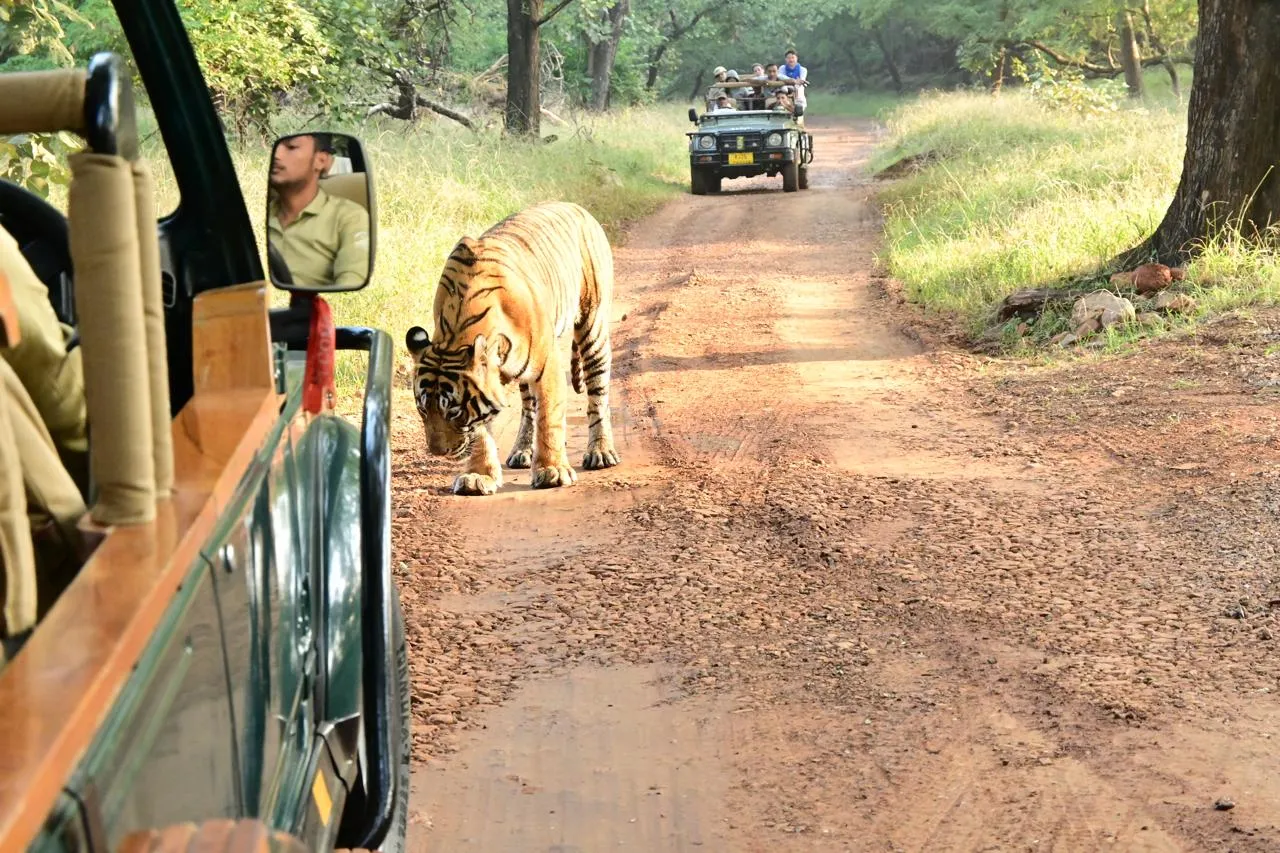
A tiger on the track in front of our guests’ gypsy, photographed on one of our safaris this season.
There is no official sighting rate for Ranthambore. The Forest Department does not publish how many safaris see a tiger, by zone or by month. Figures you see online, from “20 to 30 per cent” to “90 per cent”, come from operators and travel sites with no published method behind them, so we do not quote a percentage either.
What we can tell you is the pattern we see across our own bookings, and it is consistent with what guides in Sawai Madhopur say:
| How many drives | October to February | March to June |
|---|---|---|
| 1 safari | A real chance, but most single winter drives do not see a tiger | Better, because tigers come to water in the heat |
| 2 safaris (one evening, next morning) | A fair chance, and you see two different zones or two moods of the same zone | A good chance |
| 3–4 safaris over 2 nights | A good chance for most visitors | The best odds Ranthambore offers |
The reason more drives help so much is simple. Each drive is one fixed route in one zone for about three hours. A tiger resting in a ravine 200 metres off your track is invisible to you all morning. Three drives means three routes, three sets of waterholes and three chances to be in the right place when a tiger decides to walk.
Ranthambore has a lot of tigers in a small, open forest. At the Rajasthan Forest Department’s July 2026 count the reserve held 72 tigers, tigresses and cubs, about 50 adults and 22 cubs, up from 66 a year earlier (announced by the state’s Chief Wildlife Warden on the eve of International Tiger Day and reported by PTI). Experts quoted at the time estimated the reserve’s carrying capacity at around 40 to 50 tigers, so territories are full and tigers overlap.
Three things make those tigers easier to see than in many other parks:
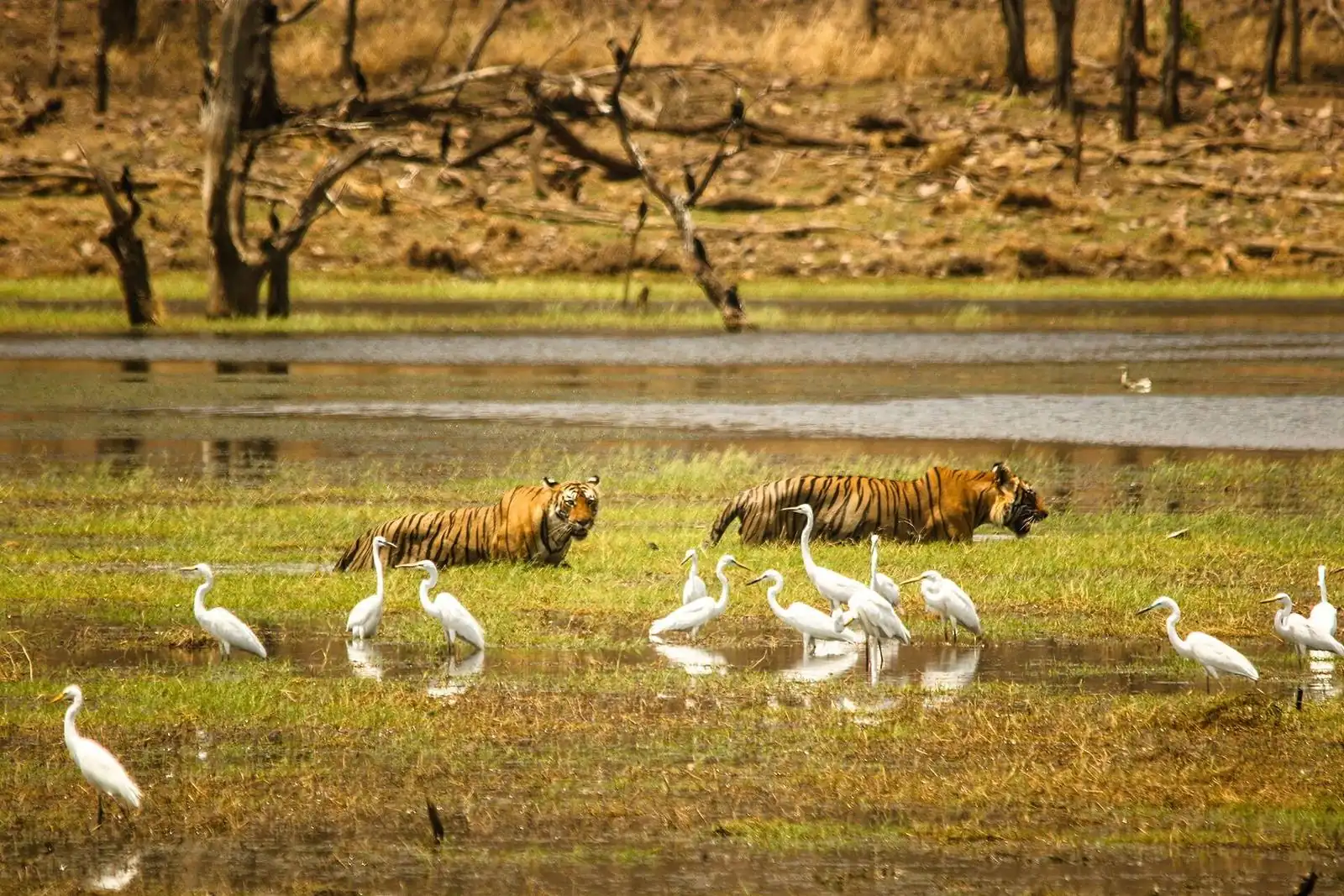
Arrowhead (T-84) and T-87 at a lake in the core zones. Photo: Zahirabbaswikiindia, CC BY-SA 4.0, Wikimedia Commons.
Got a date in mind? Send it on WhatsApp. We check live seats and reply in minutes, 7am–10pm.
Check my date on WhatsAppSeason matters more than anything else you control. The park’s core zones 1 to 5 run from 1 October to 30 June; in the monsoon, July to September, only the outer zones 6 to 10 run.
| Months | What the forest is like | Tiger sightings | Worth knowing |
|---|---|---|---|
| October–November | Green after the rains, thick undergrowth, water everywhere | Possible, harder: tigers do not need to visit the lakes | Cool, pleasant drives. Diwali week is busy and festive prices apply |
| December–January | Cold mornings, foggy starts some days | Fair. Tigers often rest in the sun on tracks and rocks mid-morning | Peak holiday crowds. Afternoon drives are warmer |
| February–March | Leaves start to fall, visibility opens up | Good and improving | Our pick for a balance of comfort and odds |
| April–June | Hot, dry, bare forest, few waterholes left | The best of the year: tigers stay near water | Hot (40 °C+ by May). Carry water, cap and scarf |
| July–September | Monsoon. Core zones closed | Lower: only zones 6–10, dense green cover | Quiet, lush, good for birds and landscape |
For gate times by month, see Ranthambore safari timings, and for the full weather picture, the best time to visit Ranthambore, month by month.
People ask this more than anything else, and the honest answer is that there is no permanently best zone. Tigers hold territories, territories change every season, and young tigers disperse. A zone that was the place to be last year can go quiet this year.
| Zones | Why people want them | The catch |
|---|---|---|
| 3 and 4 (Padam Talao, Rajbagh, Malik Talao) | The lakes, the ruins, the classic photographs. Machli’s old ground, held in recent years by her great-granddaughter Riddhi (T-124) | The most requested routes, the most vehicles, and the hardest seats to get |
| 1, 2 and 5 (the rest of the core) | Resident tigers, waterholes, fewer vehicles than 3 and 4 | Rockier, hillier drives where tigers can be harder to spot |
| 6 to 10 (the outer zones) | Their own resident tigers, fewer vehicles, open all year, easier to book | Longer drives from the hotels; zone 9 is about 45 minutes out |
Two practical points decide which zone you actually get:
For what each zone looks like on the ground, landmark by landmark, read our zone-by-zone guide to Ranthambore’s ten zones. To know which named tigers you might meet, see the famous tigers of Ranthambore.
Got dates? Send them on WhatsApp and we suggest the mix of zones and shifts that gives you the best odds for those exact days, or see Ranthambore safari booking for this week’s seat status.
Both shifts see tigers. Each has its own strengths:
If you do two drives, take one of each. If you do three, an evening, a morning and an evening is the classic pattern for a two-night stay.
Sold out online? Ask us. We book from the daily current and tatkal quotas, and you pay only after we confirm availability, with a full refund if the permit can’t be issued.
Check my date on WhatsAppA gypsy (open 4×4 jeep, six guests) and a canter (open truck, about 20 guests) drive the same zone routes and see the same animals. The difference is how you see them:
| Gypsy | Canter | |
|---|---|---|
| Guests | 6 | About 20 |
| Positioning at a sighting | Small, quick to move, easier to get a clear view | Bigger, slower, outer seats see best |
| Noise | Quieter, one group | Livelier, more people |
| Availability now | Mostly short-notice premium seats or tatkal | Current-quota seats on most dates |
| From (Indian) | ₹5,500 per seat (premium) or ₹36,000 whole jeep | ₹2,200 per seat |
If budget allows, book at least one drive in a gypsy. If not, a canter seat is a perfectly good way to see a tiger, and we would rather you did three canter drives than one gypsy drive. More on the choice in jeep vs canter in Ranthambore and the canter safari guide.
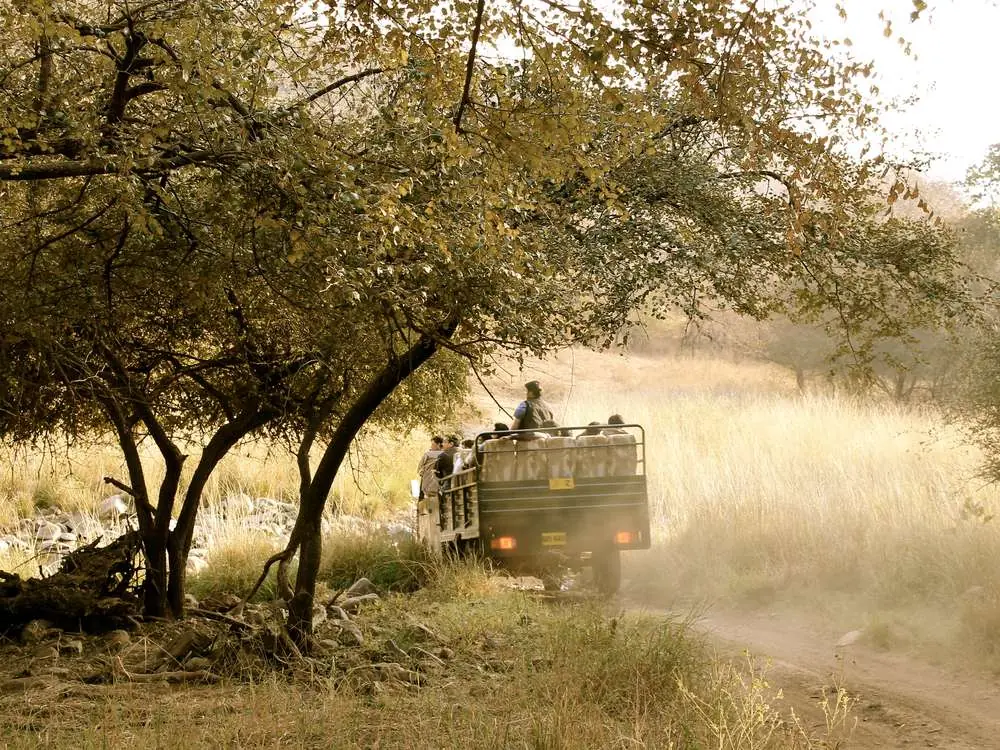
A Ranthambore guide is reading the forest the whole drive. Knowing what they look for makes the drive more interesting and helps you stay quiet at the right moments.
The best thing you can do: stay seated, keep your voice down, and when the guide says wait, wait. Many sightings come after ten silent minutes at an alarm call.
Every drive is worth it even without a tiger. These are the animals most visitors see, and the ones worth hoping for.
| Animal | How often | Where and when |
|---|---|---|
| Sambar deer, chital (spotted deer) | Almost every drive | Everywhere, often at the lakes |
| Mugger (marsh) crocodile | Most core drives | Basking at Padam Talao, Rajbagh, Malik Talao |
| Langur monkeys, wild boar, nilgai (blue bull) | Most drives | Forest and grassland |
| Birds: peafowl, storks, herons, kingfishers, eagles, owls | Every drive | Lakes in winter are especially rich |
| Leopard | Occasionally | Rocky hills and cliffs, often at the edges of tiger territory |
| Sloth bear | Occasionally | Rocky areas, more often in the dry months |
| Chinkara (Indian gazelle), striped hyena, jungle cat | Occasionally to rarely | Open grassland in the outer zones; hyena around dusk |
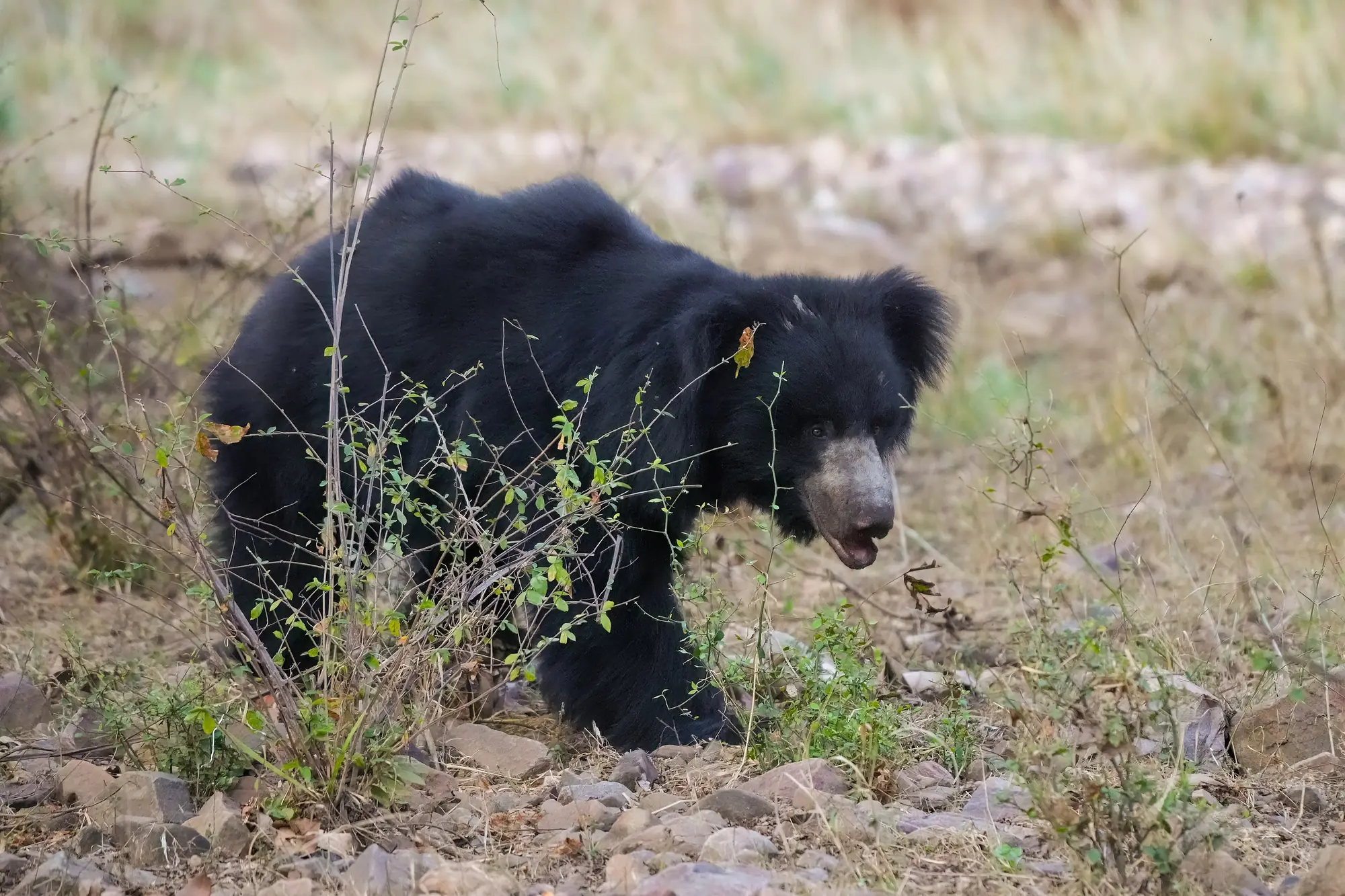
Sloth bear in Ranthambore. Photo: Giles Laurent, CC BY-SA 4.0, Wikimedia Commons.
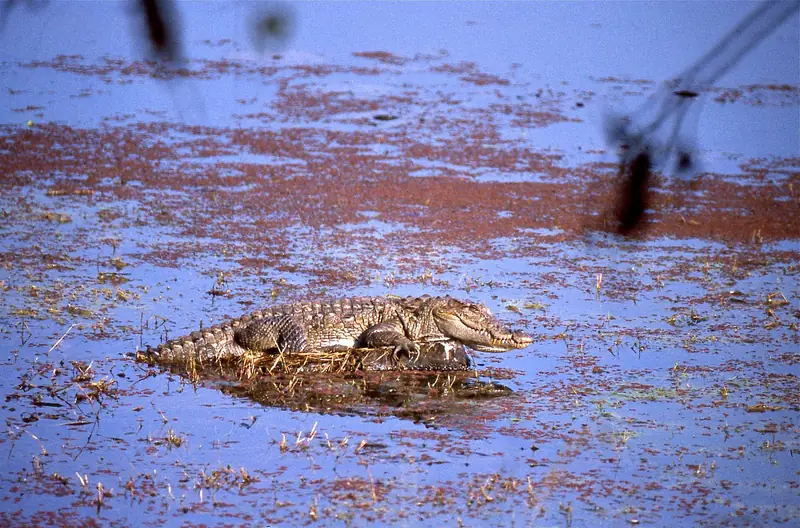
Mugger crocodile at a Ranthambore lake. Photo: Bernard DUPONT, CC BY-SA 2.0, Wikimedia Commons.
It happens, even to people who come back every year. A few things to know so it does not spoil the trip:
Ranthambore’s tigers are wild animals sharing a busy park with thousands of visitors. The park rules exist for them and for you:
For most visitors this is the plan we suggest:
As a guide to cost for an Indian national: three current-quota canter drives in zones 6–10 come to ₹6,600 per person all-in; with two core drives instead, ₹7,200. On festive dates (Diwali week and 20 December to 2 January) a canter seat is a flat ₹3,500.
Good but never guaranteed. No official sighting rate is published, so treat any percentage you read online with caution. From our bookings, a single winter safari is a real chance but often ends without a tiger, while two nights and three or four safaris give most visitors a good chance, and April to June is the easiest time because tigers stay near water.
There is no permanently best zone. Zones 3 and 4, with Padam Talao, Rajbagh and Malik Talao, are the most famous and most requested, but every one of the ten zones has resident tigers and territories change each season. The Forest Department allots zones; on short-notice seats you can pay more for core zones 1–5 or for zone 2, 3 or 4.
April, May and June give the best odds, because the forest is bare and tigers stay close to the few waterholes left, but it is very hot. February and March are a good balance of comfort and sightings. October to January is pleasant but the cover is thicker, so sightings take more luck.
Both see tigers. Mornings catch tigers still moving after the night and fresh pugmarks on the tracks; afternoons are better in the hot months when tigers come to water, and warmer in winter. With two drives, do one of each.
Not more tigers: both vehicles drive the same zone routes. A six-seat gypsy is quieter and quicker to position at a sighting, so the view is often better. A canter seat costs far less (from ₹2,200 per person for Indian nationals), so three canter drives usually beat one gypsy drive for your chances.
72 at the Rajasthan Forest Department’s July 2026 count, about 50 adults and 22 cubs, up from 66 a year earlier. Experts estimate the reserve can comfortably hold about 40 to 50, so territories are crowded and young tigers move out to other reserves.
There is no refund for not seeing a tiger, anywhere in India: the permit is for a drive, not a sighting. You can often book another drive at short notice, because current-quota canter seats are released at 10 am the day before. Message us before 10 am and we try for the next morning.
Send us your dates and group size. We suggest the right number of drives, zones and shifts, check live seats and reply within minutes, 7 am to 10 pm IST. We confirm availability before you pay, and if a permit can’t be issued you get a full refund (tatkal is non-refundable once issued).
 RANTHAMBORE